

Working with 3D models often means dealing with different Productivity file formats. One application may prefer OBJ, another may work better with STL, while modern 3D workflows frequently use GLB. When you move a model from one tool to another, format compatibility can quickly become a frustrating part of the process.
A 3D Model Format Converter Productivity can make that process much simpler. Instead of manually editing a model file or opening it in a full 3D application just to make a basic conversion, a browser-based converter can handle the file directly in the page.
The tool described here is designed around a simple idea: make 3D model conversion easier while also giving users useful information about the mesh before they import it somewhere else.
It supports working with common formats such as OBJ, STL, and GLB, while also providing mesh statistics that can help users understand what is inside their model.
What Is a 3D Model Format Converter Productivity?
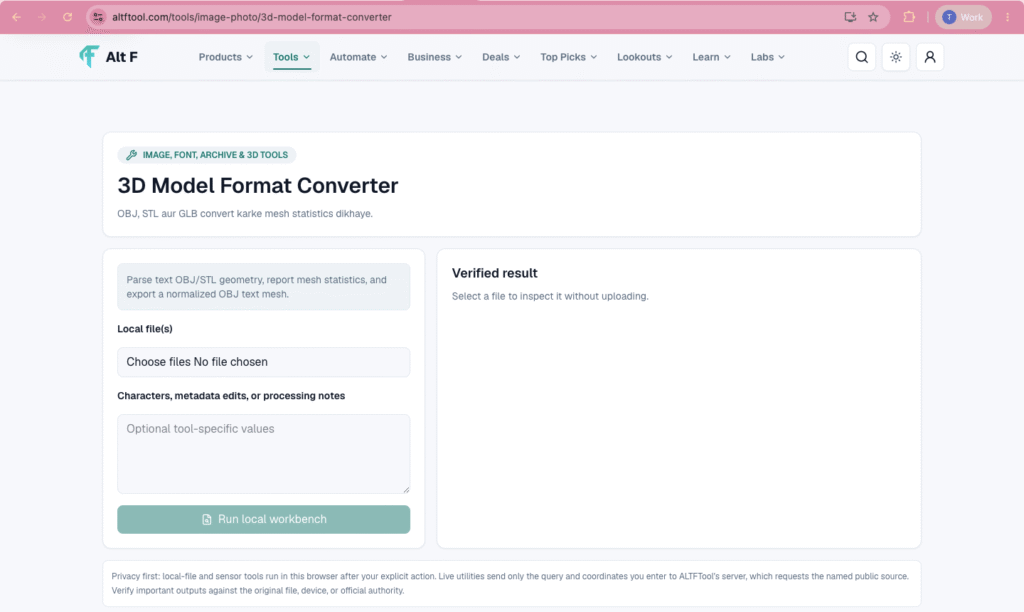
A 3D Model Format Converter is a tool that helps change a 3D model from one file format into another.
Different 3D applications and platforms support different formats. For example, OBJ is a widely used format for storing polygonal geometry, STL is commonly associated with 3D printing, and GLB is useful for sharing 3D scenes and models in a compact binary format.
Without a converter, switching between these formats may require installing dedicated 3D software. That can be unnecessary if you only need to prepare a model for another application.
A browser-based converter provides a more convenient alternative. You can upload or select a model, allow the tool to process it, review important mesh information, and download the resulting file.
The main benefit is simplicity. You do not need to turn a basic format conversion into a complicated editing workflow.
Why 3D Model Formats Matter Productivity
A 3D model is not simply a picture. It contains information that describes the shape and structure of an object.
Depending on the format, this information can include vertices, faces, normals, textures, materials, and other scene-related data.
The format determines how this information is stored and how another application can interpret it.
For example, an OBJ file commonly stores geometry as readable text. Vertex positions are represented using v lines, while polygon faces are represented using f lines.
STL takes a different approach and is particularly associated with surface geometry and 3D printing workflows.
GLB, meanwhile, is a binary form of glTF that can package 3D assets into a convenient file for modern applications and real-time experiences.
Because these formats are structured differently, conversion is sometimes necessary when moving a model between different tools.
Converting OBJ, STL and GLB Productivity
The 3D Model Format Converter is intended to work with three popular formats: OBJ, STL, and GLB.
This makes it useful for people who regularly move models between different environments.
An artist might create or export a model in OBJ and later need another format. A 3D printing workflow may involve STL. A developer or designer working with real-time 3D content may prefer GLB.
Having access to several common formats in one place can reduce the need to search for a separate tool every time a different file type is required.
The exact conversion process can depend on the source and destination formats, but the overall goal remains the same: prepare the model in a format that works with the next application or platform.
How the OBJ Processing Works Productivity
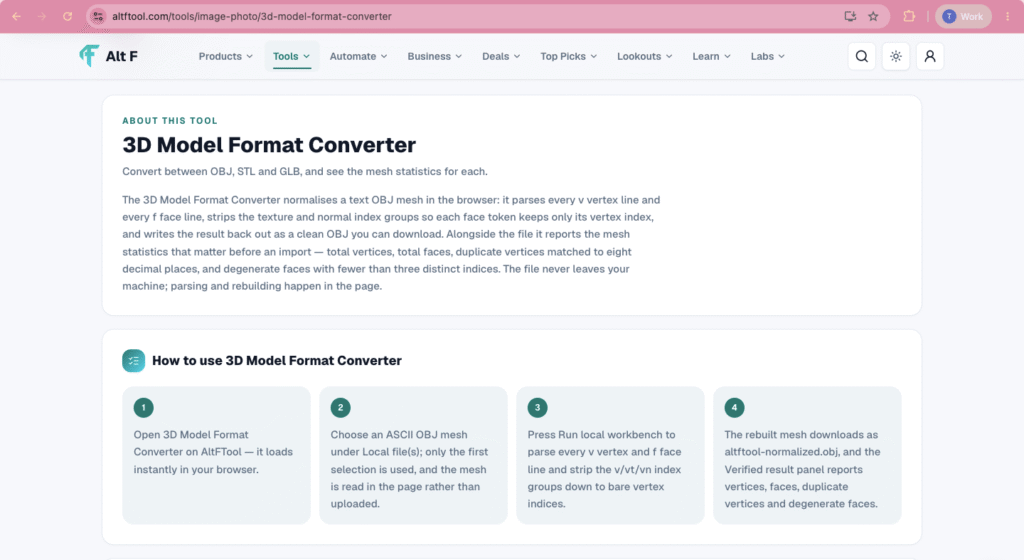
One of the interesting parts of this tool is the way it handles text-based OBJ meshes.
Instead of treating the OBJ file as an opaque object, the converter reads the geometry information contained inside the file.
It looks for the lines that define vertices and faces.
A typical OBJ file contains vertex information using lines beginning with v. These lines describe the positions of individual points that make up the model.
Faces are represented using f lines. A face connects multiple vertices together to create a polygonal surface.
The converter parses these lines and rebuilds the mesh information into a cleaner OBJ structure.
This approach is especially useful when an OBJ file contains additional information that is not needed for the particular conversion task.
Removing Texture and Normal Index Groups Productivity
OBJ face definitions can sometimes contain more than just vertex indexes.
A face token may reference a vertex, texture coordinate, and normal at the same time. This can make the structure look more complicated than a simple list of vertex references.
The converter strips away these additional texture and normal index groups so that each face token keeps only its vertex index.
In simple terms, it focuses on the geometry itself.
For example, an OBJ face reference may contain several pieces of information separated by slashes. The converter extracts the vertex index and uses that as the essential reference for rebuilding the face.
This creates a cleaner OBJ representation that focuses on the mesh’s vertex and face structure.
Why Clean OBJ Geometry Can Be Useful Productivity
A clean mesh can make it easier to diagnose compatibility problems.
Sometimes an OBJ file contains information that a particular application does not handle exactly as expected. While texture coordinates and normals can be important in many workflows, they are not always necessary when the immediate goal is simply to inspect or rebuild the basic mesh geometry.
By focusing on vertices and faces, the converter provides a straightforward representation of the model’s geometry.
This can be particularly helpful when testing whether the basic shape of a model imports correctly.
Understanding Mesh Statistics
Converting a model is only part of the job. Before importing a 3D asset into another application, it can be useful to know what the mesh actually contains.
That is why the converter also reports several mesh statistics.
These statistics include:
- Total number of vertices
- Total number of faces
- Duplicate vertices
- Degenerate faces
These numbers provide a quick overview of the model’s geometry without requiring you to inspect the entire file manually.
For someone working with large or unfamiliar 3D files, this information can be extremely useful.
Total Vertices
Vertices are the individual points that make up a 3D mesh.
A simple object may contain only a small number of vertices, while a detailed model can contain thousands or even millions.
Knowing the vertex count gives you an idea of how complex the underlying geometry is.
For example, if you are preparing a model for a real-time application, a very high vertex count may indicate that the model could require optimization.
On the other hand, a high-resolution model may intentionally contain a large number of vertices because it needs detailed geometry.
The vertex count therefore provides useful context before you move the model into another workflow.
Total Faces
Faces are the surfaces formed by connecting vertices.
A mesh can contain many different types of polygon structures, depending on how the model was created. The number of faces gives another indication of the model’s geometric complexity.
A model with a large number of faces may contain fine details, while a low-poly model will generally have fewer.
Checking the face count before importing can help you understand what you are dealing with.
For developers, designers, and 3D artists, these statistics can also be useful when comparing different versions of the same model.
Duplicate Vertices
The converter also checks for duplicate vertices.

Two vertices may have exactly the same position even though they appear as separate entries in the model’s vertex list. These duplicates can increase the size or complexity of the mesh without necessarily adding new geometric information.
The tool identifies duplicate vertices by matching their positions to eight decimal places.
This provides a practical way to detect vertices that are effectively occupying the same location.
Duplicate geometry can occur for several reasons, including the way a model was exported or assembled.
Finding these duplicates does not automatically mean that a model is broken. However, the information can help when diagnosing mesh structure or looking for opportunities to clean up a model.
Degenerate Faces
Another useful statistic is the number of degenerate faces.
A normal face needs at least three distinct vertex indexes to define a surface. A face with fewer than three distinct indexes cannot properly describe a normal polygon.
These are considered degenerate faces.
For example, if a face references the same vertex repeatedly instead of using three distinct vertices, it does not create a meaningful surface.
Detecting these faces can help identify potential geometry problems before a model is imported into another program.
Again, the presence of degenerate faces does not necessarily mean the entire model is unusable. It simply provides information that may be worth investigating.
Your Files Stay on Your Machine
Privacy is another important consideration when working with 3D assets.
The described converter performs parsing and rebuilding directly in the browser. The file does not need to be uploaded to a remote server for the basic processing described here.
That means the model can remain on your own machine while the browser handles the conversion work.
This can be particularly valuable when working with private projects, unfinished designs, client assets, or other models that you do not want to send to an external service.
Local browser processing also removes the need to wait for a remote server to upload and process the file.
Why Browser-Based Conversion Is Convenient

Traditional 3D software can be incredibly powerful, but it can also be more than you need for a simple conversion task.
If your only goal is to convert or clean up the basic structure of a model, opening a large 3D application can feel unnecessary.
A browser-based converter offers a lighter workflow.
You can work directly from the browser, inspect the model’s basic statistics, and prepare the file for the next stage of your project.
This is especially convenient for quick checks and one-off conversions.
Who Can Use a 3D Model Format Converter?
A tool like this can be useful for a wide range of people working with 3D files.
3D artists can use it to inspect exported models and check their basic mesh structure.
Game developers can review geometry before bringing assets into a development environment.
3D printing enthusiasts may find STL-related conversion and mesh inspection useful when preparing models.
Designers can use the converter when moving assets between different creative applications.
Students learning about 3D modeling can use mesh statistics to better understand how models are constructed.
Even casual users can benefit when they receive a 3D model in an unfamiliar format and need to prepare it for another application.
A Simple Workflow for Preparing a Model

Using a converter can make the overall process straightforward.
First, select the 3D model you want to work with. The converter then processes the file in the browser.
Once the mesh has been parsed, the tool can display useful statistics such as the number of vertices and faces.
You can also see whether duplicate vertices or degenerate faces are present.
After the processing is complete, the cleaned or converted model can be downloaded and used in another application.
The workflow is simple because it focuses on the task instead of surrounding it with unnecessary features.
Why Mesh Statistics Matter Before Importing
It is easy to think of a 3D file simply as an object that should open correctly. But knowing what is inside the file can save time when something goes wrong.
Suppose a model does not import as expected. Looking at its vertex and face counts can provide an immediate clue about its complexity.
Similarly, duplicate vertices and degenerate faces can reveal structural issues that may be worth checking.
These statistics do not replace a complete 3D inspection, but they provide a useful first look.
Instead of opening a model blindly in another program, you can understand some of its basic characteristics beforehand.
Keeping 3D Conversion Simple
The biggest advantage of a tool like this is arguably its simplicity.

You do not always need a full modeling suite to perform a basic file conversion or inspect a mesh.
A focused converter can handle the repetitive technical work while presenting the information users actually need.
For many everyday 3D tasks, that is enough.
The ability to convert common formats, clean basic OBJ geometry, review mesh statistics, and download the result creates a practical workflow for anyone who regularly handles 3D files.