
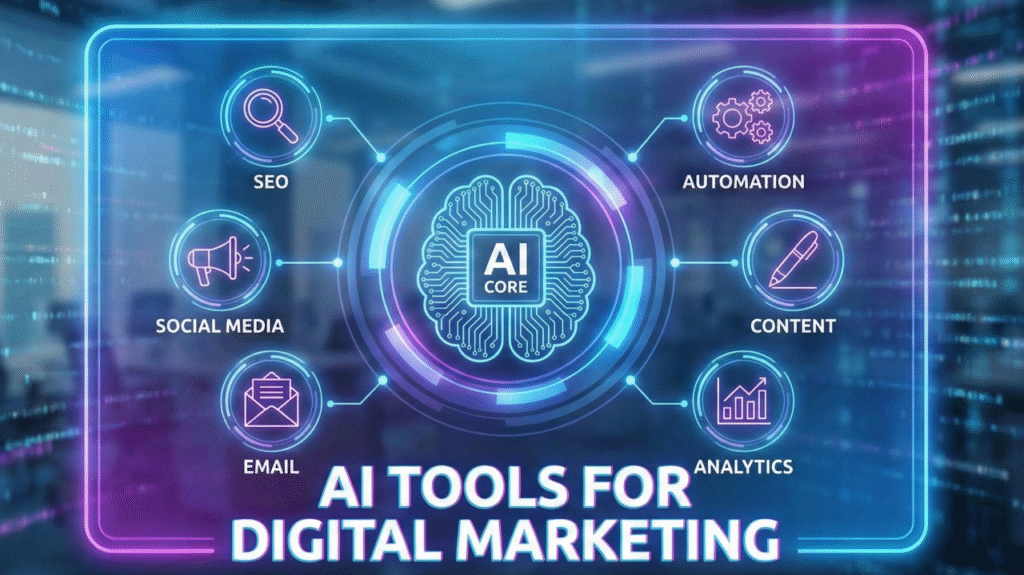
AI in digital marketing is the process of using artificial intelligence (AI) to develop, execute, refine and improve your business’s marketing strategy. It uses AI and machine learning (ML) to analyse data and automate workflows with ease. The result: actionable insights and marketing content tailored to your brand’s unique needs.Think of AI as a vehicle that can deliver all the customer insights you need and want. You can market more efficiently and create personalised content that customers love. The vehicle is definitely a fast-moving one, but don’t panic. Here’s how you can be confident in the driver’s seat.
Let’s explore the benefits of AI in marketing and the challenges businesses face, including ways you can use it to win customers, track analytics, and make the most of your investment. We’ll go through the best practices, identify future trends, and share real-world examples of companies successfully marketing with AI.
What is AI in marketing?
Artificial intelligence in digital marketing uses the capabilities of the technology such as data collection, natural language processing, machine learning, and analytics to drive better business insights and automate marketing tasks and decisions.
This data can be used to respond to and tailor a customer’s needs depending on their actions and preferences. AI is also able to adapt and improve over time using feedback and new data.
Artificial intelligence is most certainly here to stay, but it’s a welcome sight for the busy marketer. AI has the potential to revolutionise the industry forever, making it easier for brands to connect with their audiences and save time on tedious manual tasks.
The McKinsey Global Survey on AI finds that organizations are taking steps that drive bottom-line impact such as redesigning workflows as they use generative AI and put senior leaders in critical roles, such as overseeing AI governance. They are also working to mitigate any gen-AI-related risks and hiring new AI-related roles while retraining employees to deploy AI.
Examples of AI in digital marketing
The power of AI means it can be leveraged across many digital channels. Companies use it for social media campaigns, to automate tasks and processes, and for digital advertising.
Take a look at our 10 eye-opening AI marketing stats in 2025 blog to see how the technology is being leveraged to deliver results.
It can also be used in any industry. Beauty brands use it to deliver a tailored customer experience such as Sephora’s AI chatbot-powered shopping service and its Virtual Artist App.
Using AI and digital innovations, Sephora’s e-commerce sales grew from $580 million in 2016 to over $3 billion, according to Statista.
One of the most successful and well-known for using AI effectively is streaming giant Netflix. The streaming service uses the technology to provide personalized recommendations based on user preferences and behavior.
Generative AI for content and image creation

Marketing teams are often under pressure to create content quickly for many purposes and channels. However, creating good content takes time and effort, and a lot of marketers are time and resource poor.
AI copywriting tools such as ChatGPT and Claude have exploded because they help people to generate content. This could be email subject lines, ad copy, landing pages, blogs, or anything else you need for your content marketing.
You can also use AI writing prompts to create catchy headlines and customize content for your audience which drives personalization and use AI to boost your influencer marketing campaigns and manage your relationships.
Using these tools saves time and money. However, make sure to read over any content before publishing it live to ensure it has personality and fits in with your brand voice.
Speaking of content, you must also remember to optimize your content for AI because the rules have changed in terms of what search engines like Google display for their AI overviews and AI mode. To maintain visibility, you need to update your content, and you can also use the help of AI tools for this.
How to Use AI in Digital Marketing?
1. Determine Your Objectives
Start with clarity. Do you want better lead generation? Higher conversion rates? Improved retention?
Without defined goals, using AI for digital marketing becomes random and ineffective.
2. Evaluate Your Infrastructure
AI needs strong data foundations.
Assess:
- CRM systems
- Data storage capabilities
- Analytics tools
- API integrations
If your systems are fragmented, AI cannot function effectively.
3. Assess Team Capabilities
AI tools are powerful. But they need skilled teams.
Marketers must understand data interpretation. Developers must manage integration. Many businesses partner with experts offering professional Digital Marketing Services to streamline implementation.
4. Choose the Right AI Tools
Not every tool fits every business.
Select tools based on:
- Business size
- Budget
- Industry needs
- Campaign type
Avoid tool overload.
5. Test and Analyze AI Applications
Start small. Run pilot campaigns. Measure results. Refine and tweak the strategies. This can help you cut off unnecessary risks and also enhance the chances of success.
What are the challenges of AI in marketing?
Let’s look at AI and automation from a different angle. While marketing with AI helps you understand customer behaviour and personalise the timing, targeting and content of marketing activities, it’s not without its challenges.
Ethics
Ethical concerns about data privacy, security, and consumer trust call for compliance and regulations to safeguard customer information. There’s also the problem of AI bias, which could lead marketers down the AI path with false or misleading information. Combining these ethical concerns will require regular human intervention to verify the quality of AI’s information.
Expertise
Technical expertise is vital for successful AI integration. To get the most out of AI and ML models, you need experienced specialists who understand how to capitalise on the benefits while mitigating the drawbacks. Training up a skilled workforce capable of deploying, using, and optimising these tools and platforms can be a hurdle.
Data quality
For AI to produce excellent output, high-quality input is required. Poor data quality can lead to inaccurate insights and flawed decision-making. As such, businesses need to ensure their data is collected, collated, and accessible for use with AI tools. Ensuring proper data quality with unified customer profiles is also crucial.
Data quantity
Good AI relies on a solid data foundation and making AI outputs usable in the workflow. Companies that don’t collect enough data from tracking tools, surveys, and analytics may struggle to produce reliable insights that consider every angle.
Creativity
Many marketers are concerned that AI will kill creativity, especially as more brands use AI to create content. For that reason, businesses need to promote AI as an assistive tool designed to spark creativity rather than a crutch to rely on.
AI in digital marketing has its pitfalls, but by blending the power of AI with human insights and evaluation, each of these challenges can be avoided or mitigated, allowing companies to experience the full business benefits.
What is an AI copilot?
An AI copilot is an assistive, conversational experience built natively into a tech platform. It brings the power of generative AI (similar to a chatbot) into software and guides users through various tasks. These copilots deliver real-time, proactive suggestions that help users boost productivity.
These copilots are big news for marketers. They can improve overall operational efficiency by providing brand-specific insights. For instance, the right copilot could instantly create promotional material or copywriting, drawing from a wealth of data and information from across an organisation. This also leads to cost savings by reducing the hours spent creating marketing content.
For example, Einstein Copilot draws from your CRM data to provide recommendations and drafts of content, action plans, and custom code. It’s a way for marketers to be more efficient and have a subject matter expert at their fingertips.
AI marketing example: Zomato’s AI adverts
India’s premier food ordering and delivery platform, Zomato, has designed an ingenious series of AI-generated marketing ads for its various restaurants and partners.
The core adverts feature famous faces like Hrithik Roshan, Ranveer Singh, Samantha Prabhu, and Cheteshwar Pujara ordering food in different scenarios.
But celebrity cameos aren’t why these adverts are so impressive. Here’s the kicker. Using conversational AI, Zomato created millions of copies of these celebrities, who were able to tell the names of different local restaurants and offer standout dish recommendations.
FAQ’S
1. What is digital marketing with AI?
Digital marketing with AI uses artificial intelligence to analyze customer data, create content, personalize campaigns, automate repetitive tasks, and improve marketing decisions.
2. How can AI improve digital marketing?
AI can help marketers understand audience behavior, identify trends, optimize campaigns, generate content ideas, improve targeting, and make marketing workflows more efficient.
3. What are the best ways to use AI in digital marketing?
Common applications include AI-powered content creation, SEO research, customer segmentation, chatbots, email marketing, social media management, ad optimization, and marketing analytics.
4. Can AI replace digital marketers?
AI is more useful as a marketing assistant than a complete replacement for marketers. Human creativity, strategy, brand understanding, and decision-making remain important for successful campaigns.
5. Is AI digital marketing suitable for small businesses?
Yes. Small businesses can use AI to automate routine marketing tasks, create content more efficiently, understand their audiences, and improve productivity without requiring a large marketing team.