
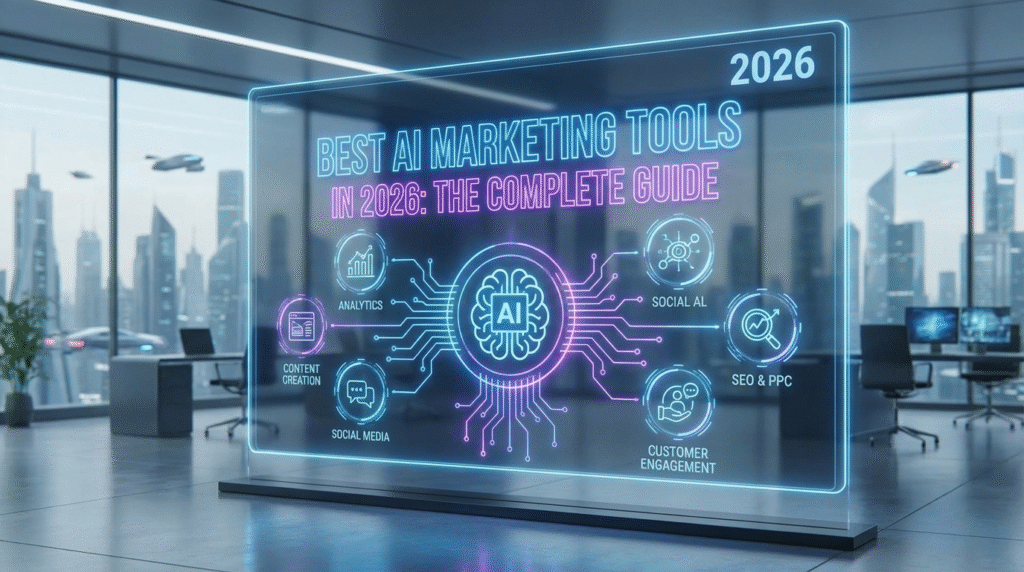
Imagine spending 20 hours per week on repetitive Digital marketing tasks—keyword research, content optimization, email sequences, and lead scoring—only to see minimal improvements in conversion rates and revenue. That was the harsh reality for most marketing teams just two years ago. Today, artificial intelligence is fundamentally reshaping how businesses approach marketing, sales, and customer engagement.
AI has revolutionized the entire marketing landscape, transforming tedious manual processes into intelligent, automated workflows that adapt in real time. Did you know that over 3,000 AI tools are available today, with nearly 300 specifically designed for SEO and marketing? As a marketer, ignoring this transformation isn’t just inefficient—it’s economically irrational.
AI marketing tools are no longer a competitive advantage; they’re a competitive necessity. With the ability to analyze billions of data signals, predict customer behavior, automate complex campaigns, and personalize experiences at scale, these tools are helping businesses skyrocket their revenue while reducing operational overhead.
This comprehensive guide explores the best AI marketing tools in 2026—from SEO optimization and content creation to sales automation, design, and account-based marketing. Whether you’re optimizing for search engines, crafting compelling copy, automating sales outreach, or running sophisticated ABM campaigns, you’ll discover the exact tools industry leaders are using to win.
Are you ready to supercharge your marketing strategy and leave competitors in the dust? Let’s dive in.
Why AI is Transforming Digital Marketing
As of 2026, McKinsey State of AI Report, 87% of marketing teams globally report using generative AI in at least one of their business workflows. This number proves that competition for online attention has been tougher. Thousands of brands compete for the same search terms, the same social feeds, and the same inbox space. AI based digital marketing changes that equation by handling drafting, scheduling, testing, reporting, and optimising.
AI processes audience and performance data at a speed no human team can match. It identifies which segments respond to which messages, adjusts bids in real time, and personalises content across millions of touchpoints simultaneously.
That kind of scale was once only available to enterprise brands. Now, it is accessible to teams of any size. Businesses that adopt digital marketing AI tools consistently outpace those that do not, and the gap continues to widen.
The Data-Driven Imperative
Marketing in 2026 is defined by one undeniable truth: data drives everything. Successful marketers no longer make decisions based on intuition or outdated best practices. Instead, they leverage AI to process vast amounts of customer data, identify patterns invisible to the human eye, and act on predictive insights in real time.
AI marketing tools deliver three critical advantages that separate market leaders from struggling competitors:
Speed & Efficiency: AI automates time-consuming tasks, reducing the time required for keyword research from 5 hours to 30 minutes, content optimization from 3 hours per page to 30 minutes, and technical audits from 8 hours to 1 hour.[artifact:web:1] This efficiency multiplies across entire marketing teams, enabling small teams to deliver enterprise-scale results.
Personalization at Scale: AI analyzes individual customer behavior, preferences, and purchase intent to deliver personalized experiences to thousands or millions of prospects simultaneously. This level of 1:1 personalization—once reserved for premium accounts—is now standard across mid-market and enterprise organizations.
Predictive Intelligence: Modern AI marketing tools don’t just analyze historical data; they forecast future trends, predict which leads will convert, anticipate algorithm changes, and recommend the next best action for every prospect. This predictive layer transforms marketing from reactive to proactive.
AI Marketing Workflow in Digital Marketing (Step-by-Step Guide)
The real value of AI digital marketing tools comes from combining them into a repeatable workflow, not using each of them separately. Here is a step-by-step guide that helps to understand how the flow actually works.
Step 1: Data Analysis and Audience Segmentation
Data analysis and audience segmentation help keep the workflow intact by removing the need for manual segmentation. AI tools identify the right group of audience and deal with previous customer data. This helps to group the correct audience based on their purchasing history.
Step 2: Content Creation

Users these days need content that is not only personalised but also connects emotionally. Generative AI tools orchestrate the best content outline based on just prompts and tailor it into social media posts and long-form content.
Step 3: Paid Media and Ad Optimisation
A business that is running on a tight budget can not spend a huge amount on digital ads. Sometimes businesses start spending on ads without accurate planning. AI removes this guesswork and helps digital marketers avoid wasting on the wrong campaigns.
Step 4: Lead Capture and Nurturing
Instead of traditional fill-ups, AI helps with potential lead capture and nurturing. It instantly reaches users, ensuring personalised follow-up. Such leads can add value to a brand’s growth and help to generate revenue.
Step 5: Performance Tracking
Performance tracking is crucial to learning how a business is going. Review Google Analytics 4 weekly. This helps to gather AI-generated insights to refine the next content cycle. The refinement adds value and helps brands to connect to more potential consumers.
Remember that teams that combine ChatGPT for ideation, Surfer SEO for optimisation, Canva AI for visuals, and HubSpot for automation can consistently outperform any other competitors or those who use a single tool for their marketing campaigns.
Top AI Tools for SEO & Content Optimization
Understanding AI-Powered SEO in 2026
AI has fundamentally transformed search engine optimization. Traditional SEO required months of manual keyword research, competitive analysis, and content optimization. Today, AI SEO tools analyze search engine results pages (SERPs), competitor strategies, and user intent in seconds, providing data-driven recommendations that improve rankings faster.
AI SEO capabilities now include:
- Semantic keyword research identifying related terms and user intent
- Content gap analysis identifying topics competitors rank for but you don’t
- Predictive analytics forecasting which keywords and topics will trend
- Automated on-page optimization suggestions for every element
- Technical SEO audits identifying crawl errors, site speed issues, and mobile optimization gaps
- SERP feature optimization for featured snippets, People Also Ask boxes, and position zero rankings
Can AI Replace Digital Marketers?
No. AI can never replace digital marketers. It can only automate seamless execution. If applied properly, it drafts, schedules, optimises, and reports. But what it cannot do is understand why a brand exists, what a customer truly values about a brand, or how to build trust over time.
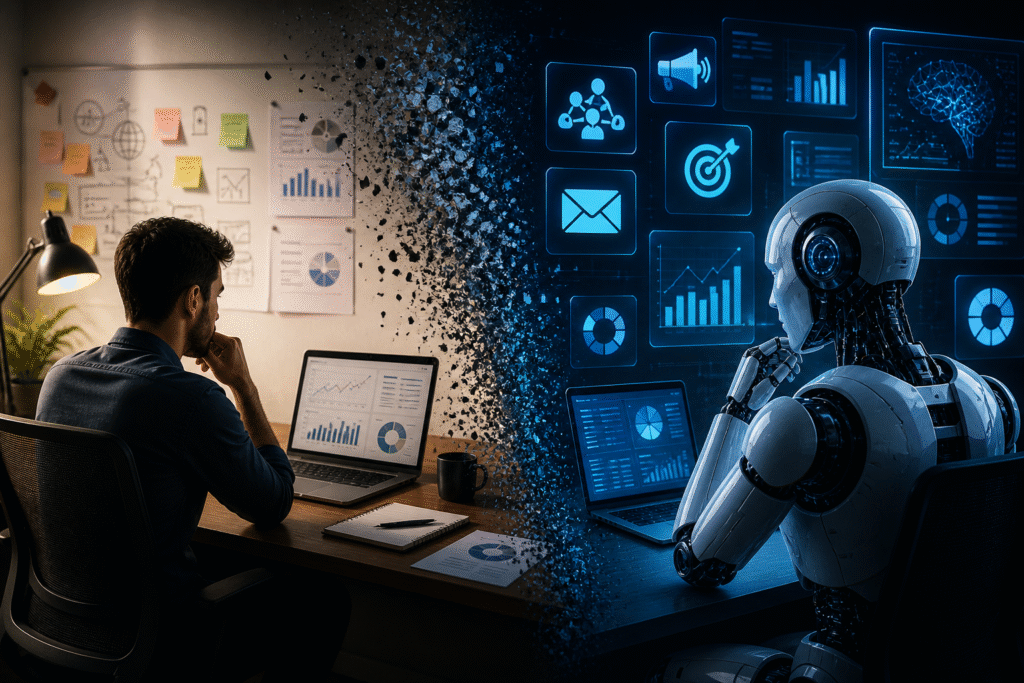
Also, AI cannot make the judgment calls that define a strong strategy, navigate cultural context, or know when to stay quiet. It means the job role of digital marketers is currently evolving, not disappearing. Marketers who combine core skills with strong AI tool proficiency can gain a significant advantage. Those who ignore that shift or fail to adapt to the latest trends may find their roles increasingly constrained.
Moreover, the application of AI in digital marketing is a combination of human strategy and AI execution, which is winning right now.
FAQ’S
1. What is AI in digital marketing?
AI in digital marketing uses artificial intelligence to improve tasks such as content creation, customer targeting, data analysis, personalization, and automation.
2. How can AI improve digital marketing?
AI can help marketers analyze customer behavior, create content ideas, automate repetitive tasks, personalize campaigns, and make faster data-driven decisions.
3. What are the best AI tools for digital marketing?
AI writing tools, analytics platforms, chatbots, image generators, SEO tools, and marketing automation platforms can support different digital marketing tasks.
4. Can AI help with SEO?
Yes. AI can assist with keyword research, content planning, search intent analysis, content optimization, and identifying opportunities to improve website visibility.
5. Is AI replacing digital marketers?
AI is more commonly used as a support tool. It can automate repetitive tasks, while marketers still provide strategy, creativity, brand understanding, and human judgment.